If you’re thinking about hanging a swing from a tree, you’re already doing the right thing by asking this question first. Most people skip this step—and that’s where problems start. A branch might look strong, but trees fail in very predictable ways when weight, movement, and time are involved.
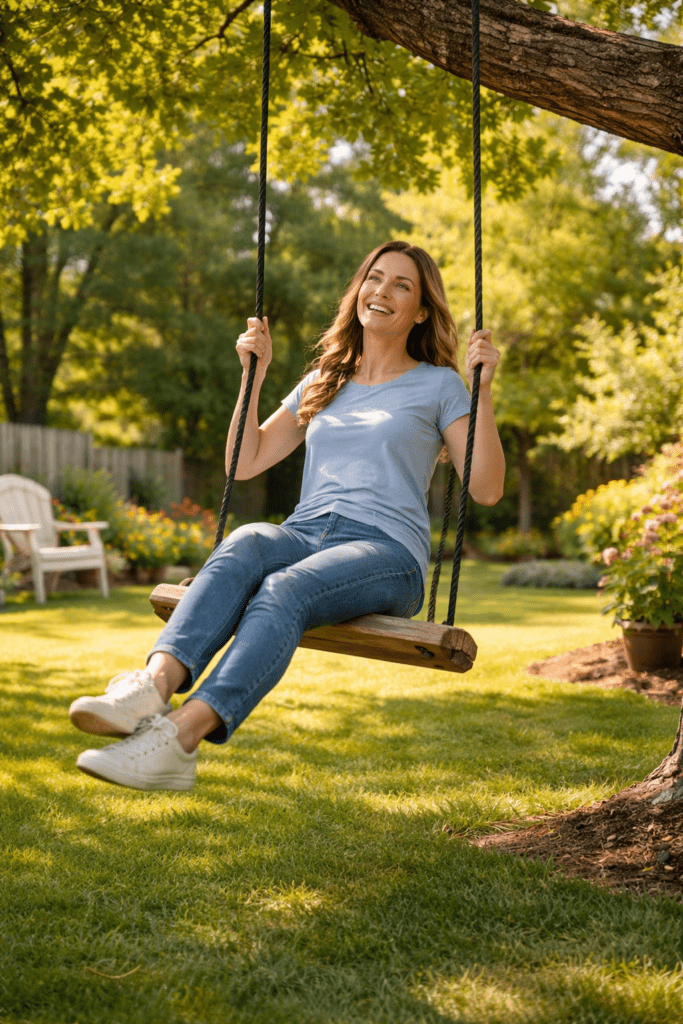
I’ve seen solid-looking branches crack within minutes simply because the wrong tests were used (or no tests at all). The goal here isn’t just to “see if it holds”—it’s to evaluate strength, stability, and long-term safety before anyone gets on that swing.
Let’s walk through exactly how to do it the right way.
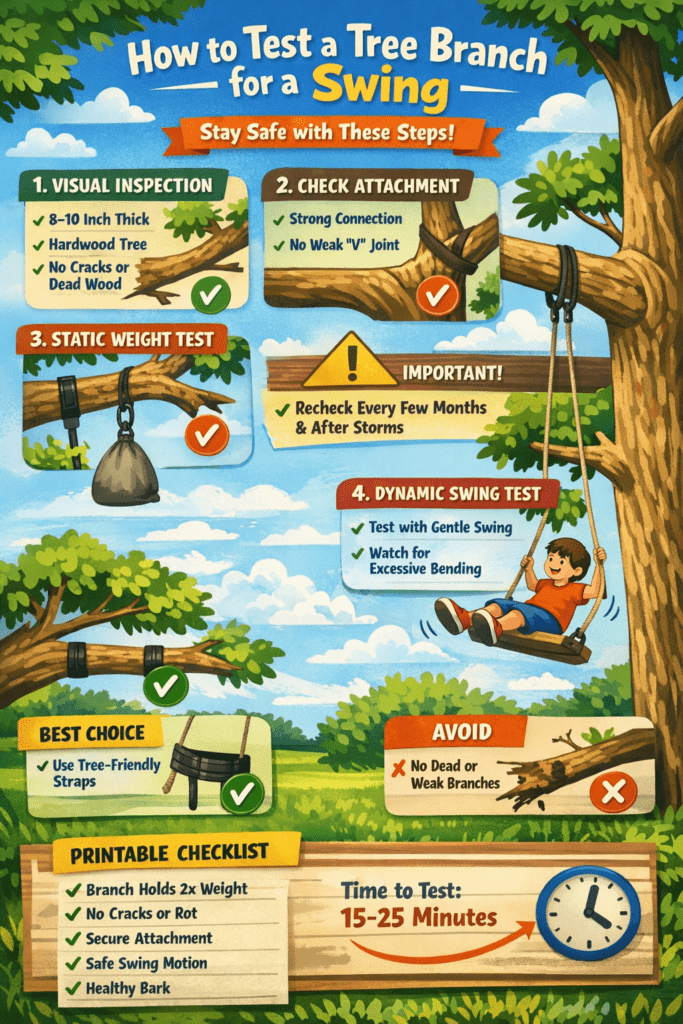
Step 1: Start with Visual Inspection (2–5 minutes)
Before you touch anything, step back and evaluate the branch.
Look for:
- Diameter: At least 8–10 inches thick for a single swing
- Tree type: Hardwood trees (oak, maple) outperform softer woods
- Branch angle: Slight upward angle is stronger than flat or downward
- Cracks or splits: Immediate red flag
- Dead wood: No leaves during growing season = don’t use it
If you’re unsure about tree types or branch strength, this guide helps clarify.
👉 If the branch fails visually, don’t waste time testing—it’s not safe.
Tree Swing Weight Limit Calculator
Use this calculator to estimate whether a tree branch looks suitable for a swing based on branch size, tree type, branch condition, and rider load. This is a conservative screening tool, not a structural guarantee.
Enter Your Setup
- Choose a thick branch attached close to the trunk.
- Use straps when possible to reduce bark damage.
- Recheck the branch after storms and heavy use.
- Use wide tree swing straps to spread load and protect bark.
- If you see cracks, rot, fungal growth, or a weak branch union, choose another branch.
Step 2: Check Attachment Strength (3–5 minutes)
Where the branch connects to the trunk matters more than the branch itself.
You want:
- A wide, thick connection point
- No visible separation or bark peeling
- No “V-shaped” weak unions (these split easily)
A strong branch grows like a natural extension of the trunk—not like it’s just stuck on.
Step 3: Perform a Static Weight Test (5–10 minutes)
Now you’re going to apply controlled weight.
How to do it:
- Toss a rope or strap over the branch
- Gradually hang weight (start light, then increase)
- Use your body weight slowly—don’t jump
What to watch for:
- Flexing: Some bend is normal
- Cracking sounds: Immediate stop
- Sudden movement: Not safe
A good rule:
👉 The branch should hold at least 2x the expected load
So if a child (or adult) will swing at ~150 lbs, you want that branch comfortably holding 300 lbs or more. For proper setup after testing, see: How to Hang a Tree Swing
Step 4: Test Dynamic Movement (5 minutes)
Static weight isn’t enough—swings introduce motion, which multiplies force.
Once the branch passes the static test:
- Sit on the rope or swing
- Gently start swinging
- Gradually increase motion
Watch for:
- Excessive bouncing
- Deep flexing at the attachment point
- Bark tearing where straps contact the branch
👉 Movement adds stress. A branch that “barely passes” static testing will fail over time with swinging.
Step 5: Inspect the Bark and Surface (2–3 minutes)
Even a strong branch can be damaged by poor installation.
Look for:
- Rough or flaky bark
- Signs of rot or fungus
- Insect damage (small holes or soft spots)
Using proper straps instead of rope reduces long-term damage. Find out why here.
Realistic Expectations (This Is Where People Get It Wrong)
Here’s the truth most people don’t want to hear:
- Trees are not static structures—they weaken over time
- Weather (wind, rain, heat) changes strength
- Repeated swinging causes fatigue in wood fibers
That means:
👉 Passing a test today does NOT guarantee long-term safety
Plan to:
- Recheck every few months
- Inspect after storms
- Replace or relocate if anything changes
Trade-Offs and Risks
Stronger Branch = Less Flex, More Stability
- ✔ Safer for heavier use
- ❌ Harder to find
Slight Flex = More Comfortable Ride
- ✔ Better “bounce”
- ❌ Higher long-term stress risk
Rope vs Straps
- Rope = cheaper, more abrasion risk
- Straps = safer, tree-friendly, longer lifespan
Lower Height vs Higher Height
- Lower = safer falls
- Higher = better swing arc (but more force on branch)
Printable Checklist
Tree Branch Safety Checklist
✔ Branch is 8–10 inches thick minimum
✔ Hardwood tree (oak, maple, sycamore preferred)
✔ No cracks, splits, or dead wood
✔ Strong trunk connection (no weak “V” joints)
✔ Holds 2x expected weight without stress
✔ Minimal flex during movement
✔ Bark is intact and healthy
✔ Using tree-safe straps (not bare rope)
✔ Rechecked after storms or heavy use
Time to Complete: 15–25 minutes total
More Tips:
For safer installation and testing:
- Tree swing straps (wide, non-damaging):
https://www.swingsfortrees.com/tree-swing-hanging-kit/ - Step-by-step install guide:
https://www.swingsfortrees.com - Tree selection help:
https://www.swingsfortrees.com/tree-swing-comparison/
Frequently Asked Questions
How much weight should a tree branch hold for a swing?
At least 2–3 times the expected load. This accounts for motion and long-term stress.
Can I test a branch just by pulling on it?
No. Pulling doesn’t replicate real forces. You need a progressive weight test.
Is a slightly bending branch safe?
Some flex is normal—but deep bending or creaking is a warning sign.
What’s the safest type of tree for a swing?
Hardwoods like oak, maple, and beech are ideal. Avoid brittle or soft woods.
Should I use rope or straps?
Straps are better. They distribute weight evenly and protect the tree.
How often should I recheck the branch?
Every few months—and always after storms or heavy use.
Conclusion
Testing a tree branch isn’t complicated—but it does require discipline. Most failures happen because someone rushed the process or assumed a branch was “probably fine.”
Take 20 minutes to do this right, and you’ll dramatically reduce the risk of injury and damage—to both the tree and the people using the swing.
If you want a simple rule to remember:
👉 Strong tree, thick branch, slow testing, and regular checks.
That’s the difference between a safe swing and a risky one.
Resources
- International Society of Arboriculture – https://www.isa-arbor.com/
- U.S. Consumer Product Safety Commission – https://www.cpsc.gov/
- Arbor Day Foundation – https://www.arborday.org/