If you’ve ever hung a tree swing (or even just thought about it), you’ve probably realized something quickly—there’s a lot more to it than tossing a rope over a branch and calling it a day.
I’ve seen setups that looked fine at first glance but were actually unsafe, damaging to the tree, or just frustrating to use. The good news? Most mistakes are easy to avoid once you know what to look for.
This guide walks you through the most common tree swing hanging mistakes, what causes them, and how to fix them before they become a problem.
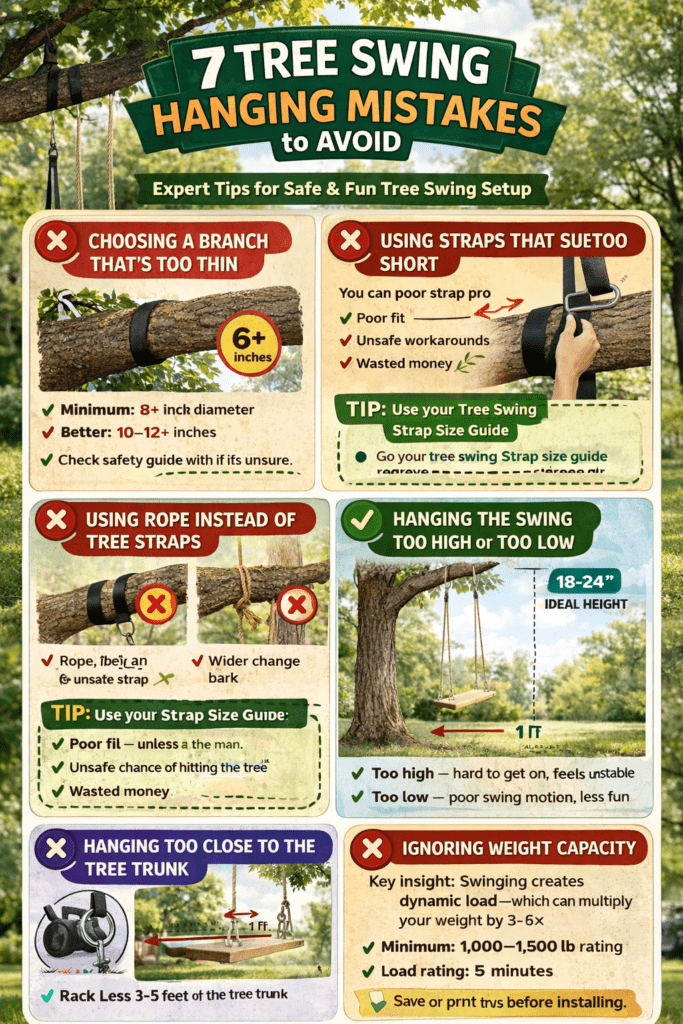
❌ 1. Choosing a Branch That’s Too Thin
This is the biggest mistake—and the most dangerous.
A branch might look sturdy, but if it’s underbuilt, it can fail under dynamic load (which is much higher than body weight when swinging).
What to aim for:
- Minimum: 8 inches diameter
- Better: 10–12+ inches
Reality check:
Even a healthy-looking branch can fail if it’s too thin or has internal weakness.
👉 If you’re unsure, use a safety-first approach and check your setup with a tool like the Tree Safety Checker:
❌ 2. Using Straps That Are Too Short
This happens all the time. People guess the length… and end up with straps that don’t reach around the branch properly.
What happens:
- You can’t secure the swing properly
- You’re forced into unsafe workarounds
- You waste money buying replacements
Better approach:
Use a calculator like our Tree Swing Strap Size Guide to match your branch height to the correct strap length.
Rule of thumb:
- 10–15 ft works for most setups
- Go longer if you’re unsure
❌ 3. Using Rope Instead of Tree Straps
Rope seems simple—but it creates long-term problems.
The trade-off:
- ✔ Rope = cheap, flexible
- ❌ Rope = damages bark, slips, less stable
Why straps win:
- Wider surface area = protects tree
- More stable under load
- Easier to install correctly
👉 If you care about both safety and your tree, straps are the better choice.
❌ 4. Hanging the Swing Too High or Too Low
This one doesn’t get talked about enough—but it affects usability more than anything else.
Ideal height:
- 18–24 inches from ground to seat
What happens if you get it wrong:
- Too high → hard to get on, feels unstable
- Too low → poor swing motion, less fun
❌ 5. Hanging Too Close to the Tree Trunk
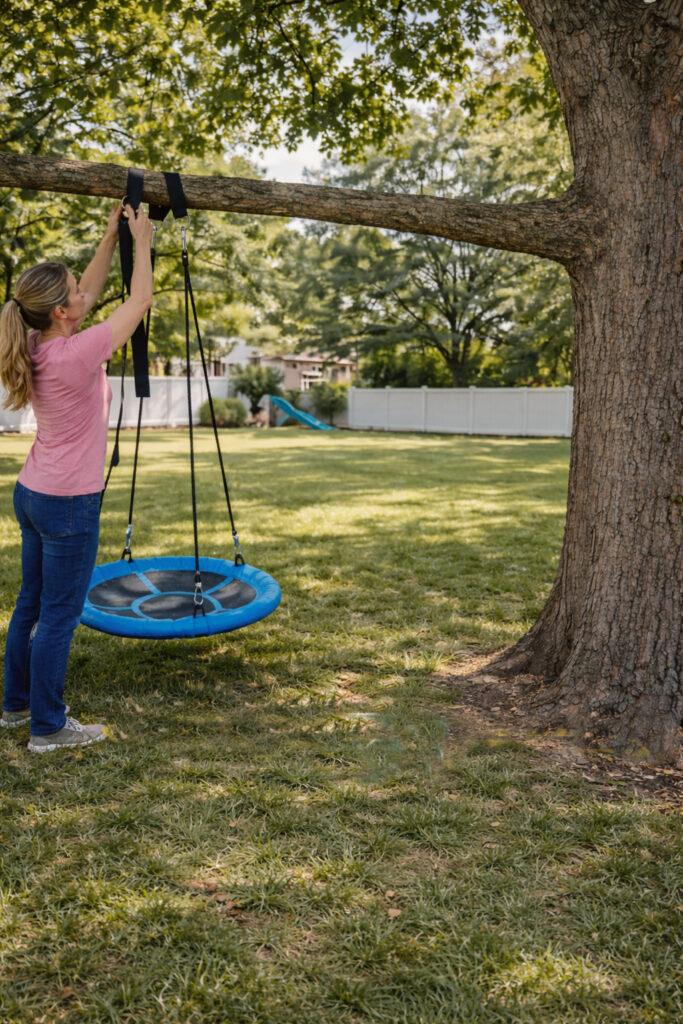
This is a sneaky one. People often hang swings directly under the branch—but too close to the trunk.
Problem:
- Reduced swing range
- Higher chance of hitting the tree
- Awkward movement
Fix:
- Leave 3–5 feet of clearance from trunk
❌ 6. Ignoring Weight Capacity
A lot of people assume:
👉 “I weigh 150 lbs, so any 200 lb strap is fine.”
That’s not how it works.
Key insight:
Swinging creates dynamic load—which can multiply your weight by 3–5x.
What to look for:
- Minimum: 1,000–1,500 lb rating
- More if adults or multiple users
👉 If you’re unsure, check product recommendations like Best Tree Swing Straps
❌ 7. Skipping a Safety Check After Installation
Even a perfect setup can fail if you don’t test it.
What to do:
- Sit gently first
- Gradually increase movement
- Re-check straps and hardware after first few uses
Time to complete:
- Initial install: 15–30 minutes
- Safety check: 5 minutes
👉 This step is quick—but critical.
🧰 Printable Checklist
Tree Swing Setup Checklist
✔ Branch is 8”+ diameter
✔ Branch is healthy (no cracks or rot)
✔ Straps are correct length
✔ Straps are wide and tree-friendly
✔ Swing height is 18–24 inches
✔ Clearance from trunk is 3–5 ft
✔ Load rating is 1,000 lb+
✔ Setup tested gradually
👉 Save or print this before installing.
❓ Frequently Asked Questions
What size tree swing straps do I need?
Most setups use 10–15 ft straps, but it depends on branch height. When in doubt, go longer.
How thick should a tree branch be?
At least 8 inches, but 10–12 inches is safer—especially for adults.
Are tree swing straps safe for trees?
Yes—wide straps are the most tree-friendly option and prevent bark damage.
How high should a swing hang?
Typically 18–24 inches off the ground for best comfort and performance.
🧠 Final Thoughts
Most tree swing problems don’t come from bad products—they come from small setup mistakes that add up.
The good news is that once you:
- choose the right branch
- use the correct strap length
- dial in height and clearance
…everything just works.
📚 Resources
- International Society of Arboriculture (ISA)
https://www.isa-arbor.com/ - ISA Public Tree Care Resource (TreesAreGood.org) (great supporting link)
https://www.treesaregood.org/
- U.S. Consumer Product Safety Commission (CPSC)
https://www.cpsc.gov/
- Arbor Day Foundation
https://www.arborday.org/ - Arbor Day Tree Care Resources
https://www.arborday.org/trees