If you’ve ever sat down on a tree swing expecting a smooth, relaxing ride—only to feel yourself sliding to one side—you’re not alone. A tilting swing is one of the most common issues I see, and the frustrating part is it usually starts small and gradually gets worse.
The good news? In most cases, it’s completely fixable without tearing everything down. But you do need to understand why it’s happening first—because the wrong fix can actually make things worse.
Let’s walk through what’s really going on and how to correct it the right way.
What Causes a Swing to Tilt?
A swing tilts when the forces on each side aren’t balanced. That imbalance usually comes from one of these key issues:

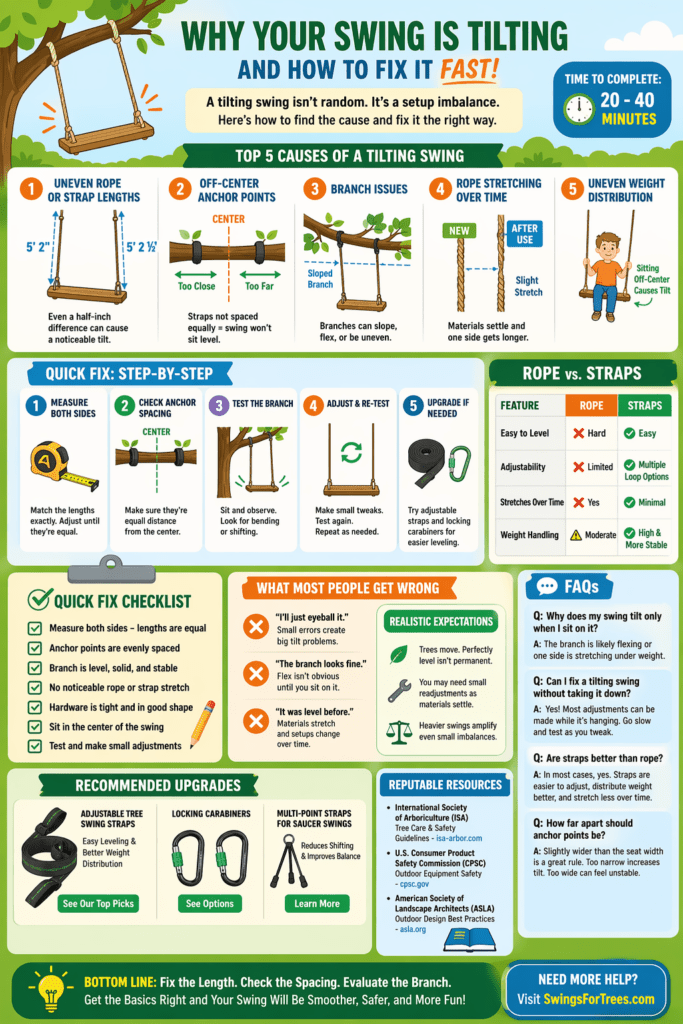
1. Uneven Rope or Strap Lengths
This is the most common culprit. Even a half-inch difference between sides can cause a noticeable tilt.
What it looks like:
- Seat leans consistently to one side
- Tilt is the same every time you sit down
Fix:
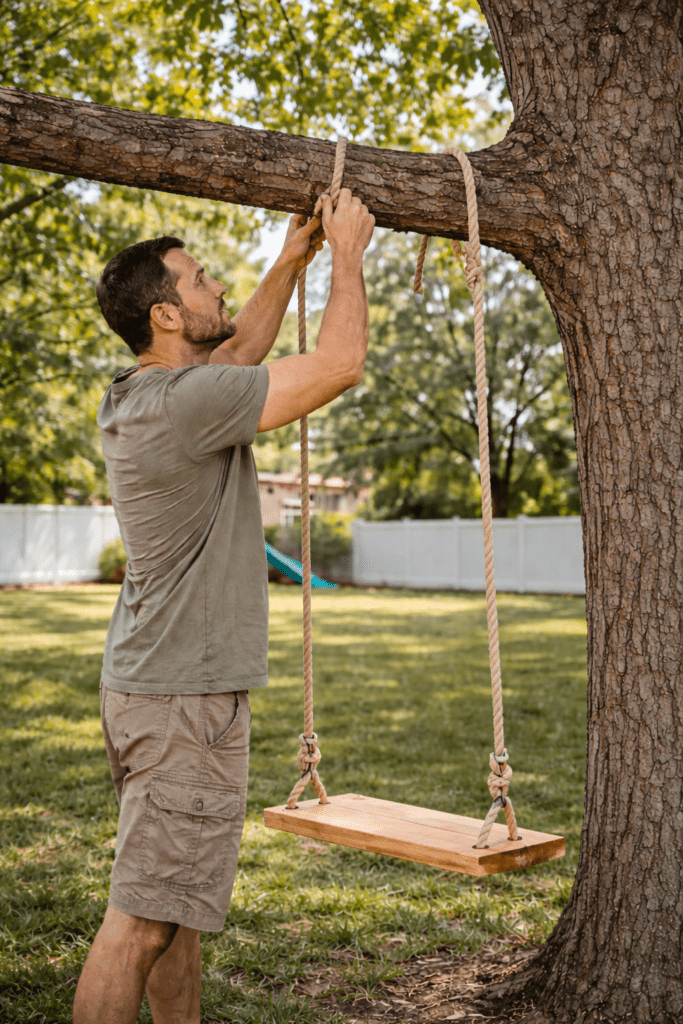
Measure both sides from the branch to the seat. Adjust until they’re exactly equal. If you need help setting this up properly, check your install basics here.
2. Off-Center Anchor Points
If your ropes or straps aren’t spaced evenly on the branch, the swing will never sit level—no matter how much you adjust the ropes.
What it looks like:
- Swing shifts or twists when in motion
- One side feels tighter than the other
Fix:
Make sure your anchor points are:
- Equal distance from the center
- Parallel to each other
- Not sliding toward each other on the branch
This becomes especially important with wider swings like saucers.
3. Branch Issues (Not as Solid as You Think)
Sometimes the problem isn’t your setup—it’s the tree itself.
Branches can:
- Slope slightly
- Flex under weight
- Be uneven in thickness
What it looks like:
- Swing looks level when empty but tilts when you sit
- Tilt changes depending on weight
Fix options:
- Move anchor points slightly to find a flatter section
- Use straps instead of rope (they distribute weight better)
- Consider a different branch if flex is significant
👉 Use this to double-check your setup safety.
4. Hardware or Rope Stretching
Over time, ropes stretch—especially under heavier loads. Cheap hardware can also shift or deform.
What it looks like:
- Swing started level but gradually tilted
- One side looks slightly longer now
Fix:
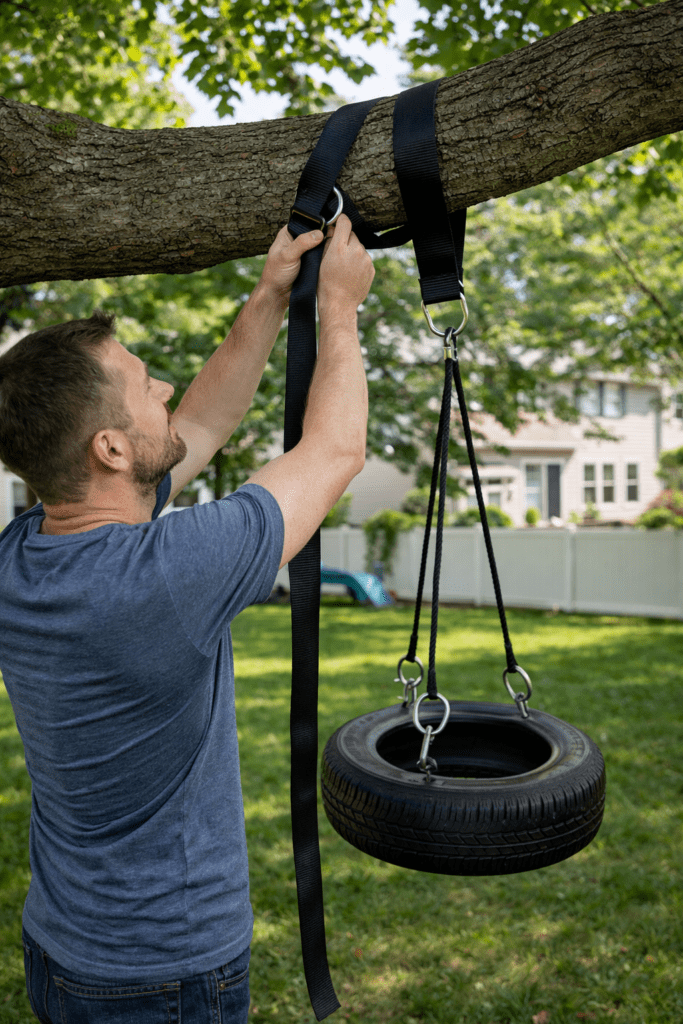
- Re-tighten adjustable straps
- Replace stretched rope
- Upgrade to weight-rated straps or hardware
5. Uneven Weight Distribution (Yes, It Matters)
This one surprises people. If the swing seat itself isn’t balanced—or if the way you sit favors one side—you’ll feel it.
What it looks like:
- Tilt changes depending on position
- More noticeable on narrow seats
Fix:
- Check that the seat is mounted evenly
- Sit centered (especially on classic plank swings)
- Consider a wider or more stable swing design
👉 If you’re deciding between styles, this comparison helps:
Step-by-Step Fix (Most Situations)
Time to complete: 20–40 minutes
- Check rope/strap lengths
- Measure both sides precisely
- Adjust until equal
- Inspect anchor spacing
- Ensure symmetry on the branch
- Reposition if needed
- Test the branch
- Sit and observe movement
- Watch for flex or shifting
- Adjust and retest
- Make small changes
- Sit again and evaluate
- Upgrade if needed
- Replace rope with straps
- Add carabiners or leveling hardware
Trade-Offs & Realistic Expectations
Here’s the honest part most guides skip:
- Perfect level isn’t always realistic outdoors
Trees move. Branches flex. Expect slightly dynamic behavior. - Straps vs rope
- Straps = easier leveling, better weight distribution
- Rope = more customizable, but harder to fine-tune
- Heavier swings need better hardware
If you’re running a 400+ lb capacity setup, small imbalances get amplified. - Frequent use = ongoing adjustments
Especially in the first few weeks as materials settle.

Printable Quick Fix Checklist
Swing Tilting Fix Checklist
✔ Measure both sides (equal length)
✔ Check anchor spacing on branch
✔ Confirm branch is level and stable
✔ Inspect for rope stretch or hardware shift
✔ Sit centered and test balance
✔ Upgrade to straps if needed
FAQs
Why does my swing tilt only when I sit on it?
That usually means the branch is flexing or one side is stretching under load. Focus on the anchor points and material strength.
Can I fix a tilting swing without taking it down?
Yes—most adjustments can be done while it’s hanging. Just make small, controlled changes and test often.
Are straps better than rope for keeping a swing level?
In most cases, yes. Straps distribute weight more evenly and are easier to adjust precisely.
How far apart should my anchor points be?
A good rule is slightly wider than the seat width. Too narrow increases tilt risk; too wide can cause instability.
Why does my saucer swing tilt more than a regular swing?
Because it distributes weight differently. Any imbalance in anchor points becomes more noticeable with wider swings.
Product Recommendations (From Real Use)
If you’re dealing with persistent tilt, these upgrades usually solve it:
- (with loops)
→ Easier leveling without retying knots - Locking carabiners
→ Fine-tune length and improve stability - Heavy-duty multi-point straps (for saucer swings)
→ Better weight distribution and less shifting
👉 You can find breakdowns and comparisons here:
Resources
Tree Safety & Branch Health Guidelines
International Society of Arboriculture
- https://www.isa-arbor.com/
- Tree Risk Assessment resources: https://wwv.isa-arbor.com/education/resources/educ_Portal_Risk_AN.pdf
Outdoor Equipment Safety Recommendations
U.S. Consumer Product Safety Commission
- Main safety hub: https://www.cpsc.gov/Safety-Education
- Outdoor Playground Safety Handbook: https://www.cpsc.gov/s3fs-public/324.pdf
🌿 Outdoor Structure Planning Best Practices
American Society of Landscape Architects
- Main site: https://www.asla.org/
- Accessibility & outdoor design principles (PDF): https://www.asla.org/getcontentasset/f846a3af-d807-492d-9876-3d694f385c28/547f34a1-c94b-4748-b717-f9bca7683a68/asla_research_accessibility_2022.pdf
Conclusion
A tilting swing isn’t random—it’s almost always a setup imbalance. The key is resisting the urge to “eyeball it” and instead making precise, small adjustments.
Start with rope length. Then check anchor spacing. Then evaluate the branch. In that order, you’ll solve 90% of cases quickly.
Get those fundamentals right, and your swing won’t just feel better—it’ll be safer, last longer, and actually deliver the relaxing experience you were aiming for in the first place.